Little Scientists, Big Discoveries
Our Reception learners recently had an exciting opportunity to take part in British Science Week, bringing science to life through a series of hands-on investigations as part of the CREST Awards programme.
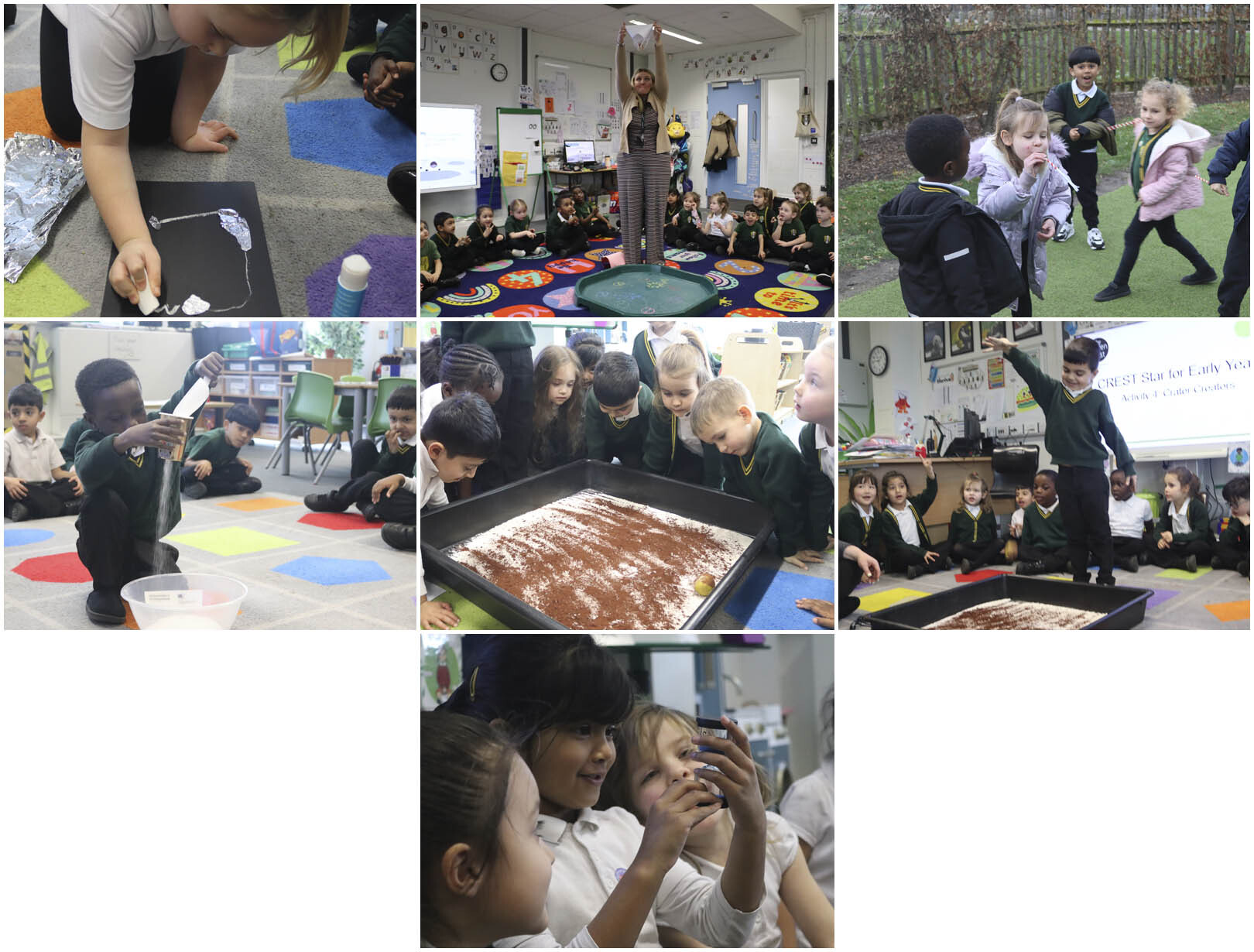
Throughout the week, our youngest learners explored, experimented and discovered the wonders of science through fun and engaging activities. One of the highlights was 'Crater Creators', where children investigated how craters form on the moon. Using trays of flour and cocoa powder, they dropped objects from varying heights to see how the “meteorites” created craters. The children were fascinated to observe how size and height affected the craters they made.
During 'Constellation Counters', the classes explored the night sky by creating their own constellations. Using star patterns and counting activities, students practised their early maths skills while learning about the shapes and patterns found in the stars.
In 'Testing Timers', students became young scientists by predicting and measuring how long different tasks would take. They then used their own homemade sand timers to measure the time taken for each. The activity encouraged curiosity, observation and discussion.
The excitement continued with 'Rocket Reach', where students designed and launched simple rockets with the aim of covering a representation of the distance between planet Earth and the Moon. The children experimented with different designs and launch methods, developing their problem-solving skills and learning through trial and improvement.
Finally, the classes tackled 'Lunar Landers', building small landing devices to help protect an “astronaut” during a drop test. This challenge encouraged teamwork, creativity and early engineering thinking as children worked together to design solutions.
Through these engaging investigations, Reception students have developed important skills such as questioning, predicting, observing and working collaboratively. British Science Week proved to be a fantastic way to spark curiosity and inspire a love of science, showing our youngest learners that exploring the world around them can be both exciting and fun.
One student, Jason, summed up the experience perfectly: “I liked testing things out to see what would happen. Being a scientist must be really fun!”