History
CURRICULUM ETHOS
History is an exciting and academic discipline that nurtures curiosity, hones our thinking and promotes the development of valuable skills. The History classroom creates the environment to communicate and wrestle with historical controversy.
While exploring the nature and complexity of History as something beyond that of ‘the past’, we are able to understand and appreciate the diverse world in which we live, where we have come from and where we may go. At Eastbrook School we aim to provide a curricular journey that is meaningful, memorable and relevant to our students. History is studied in breadth, spanning a chronological journey but also in depth through our 5 core themes. This helps us to trace change and continuity across time, account for the causes of major events and turning points and ultimately, appreciate how these moments have shaped the lives of the people at the heart of our studies.
Curriculum Intent:
• To help ALL students to engage with History, by promoting enjoyment and enthusiasm for the subject and supporting students as they draw meaning from the people and events that they study.
• To provide opportunities for students to explore a breadth of topics, time-periods and activities, nurturing reflective and independent learners.
• To develop conceptual understanding in History; helping students to cultivate and apply their historical thinking which prepares them for further study at GCSE, A Level and beyond.
The History Curriculum in Summary
We study British, European and World History subjects that cover both breadth and depth. Intended to trace 5 core themes across key stages, in a chronological way. This is underpinned by key concepts and skills which are developed across 7 years of study. We aim to create a curricular journey that is meaningful and reflects the demographic of the Eastbrook community, to develop Eastbrook School students into global citizens with a global understanding of Britain and its history and connections to Europe and the World.
Concepts and skills are developed across the c. 2000 year chronological framework at Key Stage 3. We study British, European and World History subjects that cover both breadth and depth. Concepts and skills are developed across Key Stage 3. Students trace 5 core themes:
Theme 1: Conflict and Tension
Theme 2. Power, revolution and change
Theme 3: Democracy, Equality and Human Rights
Theme 4: Empires and Decolonisation
Theme 5: The story of migration in Britain
Key Stage 4 follows the Edexcel specification, building upon the core concepts at Key Stage 3. The areas of study include a thematic unit tracing changes in crime, policing and punishment in the UK; a breadth study of Elizabethan England; a depth study looking at the wider developments in the Cold War; and a socio-political unit studying the USA at home and abroad c. 1950-1975.
KS5 completes the History journey, following the OCR specification, students study elements of British, European and world history: The Early Tudor dynasty; developments in Germany c. 1918-1963; decolonisation of the British Empire c. 1857-1965, and an independent research study that forms the coursework element of the course.
An All-Through Curriculum
The Secondary curriculum builds upon the work carried out at Primary, particularly in the studies already undertaken to explore differing viewpoints, nurture independence and research skills, and laying a foundation for historical knowledge through British depth studies. In Year 7, students will pick up from their Key Stage 2 pre-1066 studies of life in Anglo-Saxon and Viking Britain, and these form an important foundation for continuing their knowledge an understanding of developments in British History at Key Stage 3.
Diversity and Inclusion in the History Curriculum
Our curriculum offers a breadth of History, and we include a range of events, stories, and individuals from diverse British and global History. This is embedded in our schemes of work and students have enjoyed learning diverse History that is meaningful and representative of our school community, and as part of a diverse and modern Britain. Students have the opportunity to study diverse History in every year of study. For example, Year 7 will study the role and impact of significant females, often forgotten in the Medieval era; Year 8 will study pre-European African kingdoms and the individual stories of suffragettes who fought for the vote; Year 9 study global war from different perspectives, considering the contribution and experiences of a range of individuals from across the world. (Please see our curriculum maps that detail specific units.)
Cultural Capital and Enrichment in the History Curriculum
Allowing students to experience History beyond the classroom is very important at Eastbrook School. We organise several trips and visits, and whole-school opportunities.
Year 7: The Tower of London
Year 8: Hampton Court Palace, The National Archives
Year 9: The Imperial War Museum, Houses of Parliament, The National Archives
Year 10: The Houses of Parliament; Walking tour of Whitechapel (linked to their GCSE study)
Year 12: Houses of Parliament; National Portrait Gallery; The National Archives.
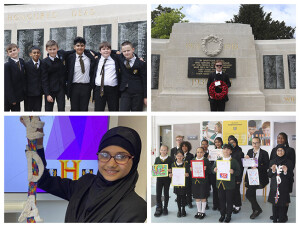
Our department also runs a popular History club for Key Stage 3 students. This involves projects studying local and hidden histories and commemorating national events such as VE Day and Black History month. Our department also delivers whole-school assemblies during Holocaust Memorial Week, Black History Month and Remembrance.
Literacy and Oracy in the History Curriculum
Mid-term and end of term assessments help students to embed core knowledge and understanding. Our assessments review knowledge, check for misconceptions more regularly, and give students the opportunity to communicate their thinking in a variety of ways, e.g. source analysis and evaluation, judgement essays, testing views and interpretations in full paragraphs. Multiple choice also helps all students to access assessment including our EAL students. Ks4 assessments are rigorous; for example, they will always follow the same format and include a knowledge section for the taught unit, followed by a conceptual understanding section which links to the specific exam objectives.
Strong literacy skills are a process and our assessments build upon one another to help students prepare for their KS4 and KS5 milestones. We support students in the use of writing frames, removing scaffolds at appropriate moments and utilising model answers that help students to build confidence and write their own reflective and concise arguments. Peer and self-assessment and improving own work helps to refine expression and communication.
Various creative lesson activities help students to build verbal communication skills and independence. For example, each Key Stage 3 group will collaborate in a ‘teach-it’ designed group challenge. Students plan and deliver mini-lessons to their peers as ‘History specialists’ and this has been successful in allowing creativity and confidence-building, as well as exploring different behaviours for learning.