Teaching
A fundamental component of our approach to teaching and learning is to measure the quality of outcome, not to micromanage the process of delivery. Giving staff autonomy and creativity in their classrooms will always be a critical part of retaining our strongest staff, achieving continues change, and diversifying student experience. Although our whole school strategy is devised with thinkers such as Rosenshine and Lemov in mind, staff members are not asked to parrot or imitate these thinkers exclusively, either verbally or in their practice. Rather, we expect staff to build on our bespoke Eastbrook School Teaching Principles and Lesson Non-Negotiables, enthusing their lessons with a discreet passion for their subjects and the wealth of their lived experience, both in teaching and beyond. We measure the quality of staff teaching in two ways.
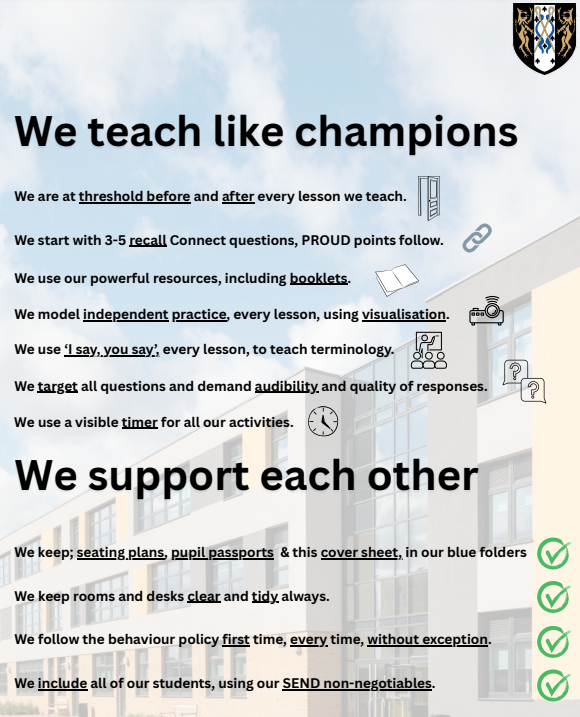
First, that our basic principles are visible throughout lessons, for instance the use of a Connect Task, complex questioning and delivering reward points.
Second, we evaluate outcomes, for instance, student engagement levels or improved academic results. When staff members are judged by outcome, not process, they have the freedom to deliver outstanding classroom experiences on their own terms, whilst remaining accountable nonetheless.
We do not expect lessons to look the same, minute by minute, but rather to follow the same curricula, guiding principles and deliver high quality outcomes. Ultimately, we ask that all lessons follow this simple structure: Connect, Consolidate, Challenge. An activity which connects to prior learning, an activity which consolidates it further, and an activity which pushes students further in learning new content. Our whole school teaching and learning strategy is divided into two primary components, namely Pedagogy and Culture.
Rosenshine’s Principles and Lemov’s Work
Our pedagogical principles are based on the traditional and highly regarded principles of Barak Rosenshine, which inform all of our planning and delivery.
Rosenshine’s Principles:
- Begin a lesson with a short review of previous learning.
- Present new material in small steps with student practice after each step.
- Limit the amount of material students receive at one time.
- Give clear and detailed instructions and explanations.
- Ask a large number of questions and check for understanding.
- Provide a high level of active practice for all students.
- Guide students as they begin to practice.
- Think aloud and model steps.
- Provide models of worked-out problems.
- Ask students to explain what they had learned.
- Check the responses of all students.
- Provide systematic feedback and corrections.
- Use more time to provide explanations.
- Provide many examples.
- Re-teach material when necessary.
- Prepare students for independent practice.
- Monitor students when they begin independent practice.
Our cultural principles are based on the Teach Like a Champion framework, authored by Doug Lemov.
Lemov articulates a range of techniques for building a classroom culture structured around: student engagement; trust; joy; accountability; and the inclusion of all students, without compromising the key tenants of rigorous academic teaching and high expectations.
Through these techniques, Lemov explains how to:
- Check for understanding.
- Raise academic expectations.
- Increase the ratio of the cognitive work students do.
- Motivate and engage students.
- Make classrooms more writing-intensive and improve discussions.
- Redirect student behaviour so it is positive and productive.
These techniques are connected to contemporary research, most explicitly in the cognitive and social sciences.
The marriage of these two approaches forms the focus on our approach to teaching and learning. For instance, when inducting a new staff member, taking an observation, or delivering a CPD session, we will ensure that resources, objectives, models and seminars, focus on these threads in practice.